
Deam Wilderness Expansion Facts
In 2023 and 2024, US Senator Mike Braun, now Indiana’s Governor, introduced legislation entitled the Benjamin Harrison National Recreation Area and Wilderness Establishment Act in Congress. Counting the adjacent 16,000-acre Brown County State Park, this legislation would establish the largest area of protected public forest in Ohio, Indiana and Illinois at the doorstep of Indianapolis, Columbus, Seymour, Bloomington and Bedford. The legislation will more than double the Charles Deam Wilderness Area, adding 15,300 acres to the north and east, expanding the wilderness from 12,953 acres to 28,253 acres.
Most of this area was first proposed to be wilderness fifty years ago by then Hoosier National Forest Supervisor A. Claude Ferguson. Legislation sponsored by Senator Birch Bayh to establish a wilderness study area on these lands included private property, prompting a sustained outcry that stopped two bills that had passed the Senate from moving through the House.
This legislation includes no private land and will not close roads to private property. Indiana Forest Alliance is working to reintroduce this legislation in the 119th Congress.

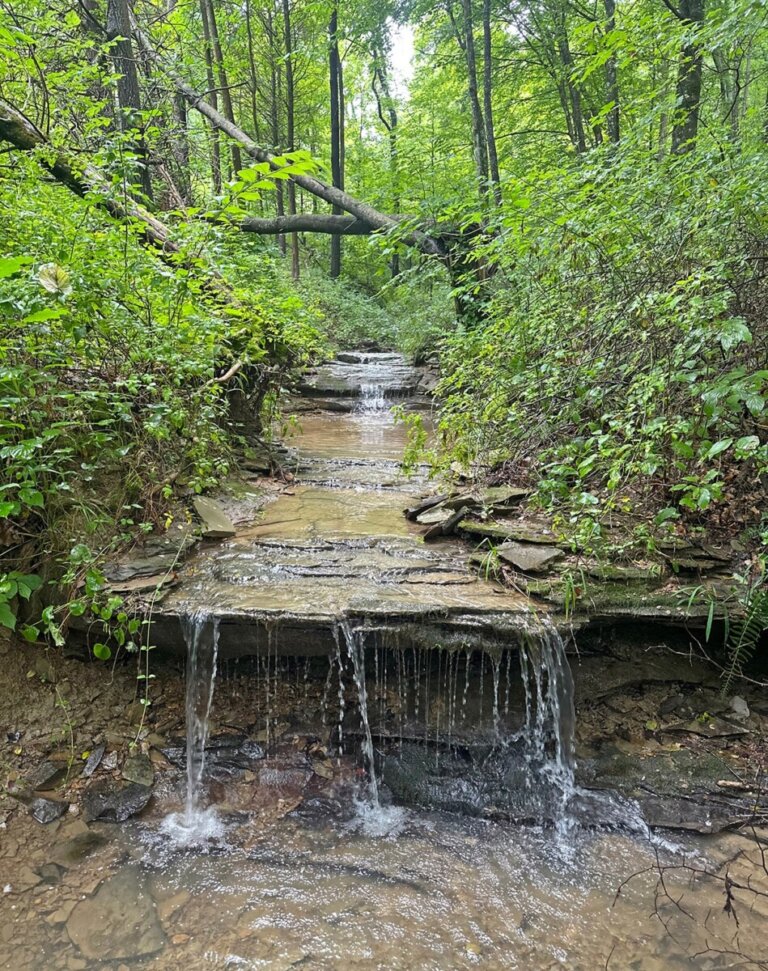
The legislation will also:
- Establish the Benjamin Harrison National Recreation Area (BHNRA) on an additional 29,382 acres of rugged, erosion-prone, national forest land explicitly to protect the Monroe Reservoir water supply and promote dispersed recreation on land surrounding the expanded 28,253-acre Deam Wilderness.
- Address concerns of mountain biking groups and government agencies. In addition to developing mountain biking trails in the NRA, 200-foot setbacks will be maintained on six trails that traverse the Wilderness expansion to permit mountain biking to continue on those trails. A 100-foot setback will be maintained along utility easements and county and state roads bordering
the expanded Wilderness. - Enhance the quality of life for Americans by protecting the pristine natural condition of an area of unprecedented size in Indiana for all types of wilderness recreation.
- Establish a Federal Advisory Committee composed of representatives of local governments, area private landowners, conservation and recreation groups, state and federal agencies, experts in dispersed recreation, ecologists and a district forester to work with the Forest Service and the public to develop a management plan for the BHNRA.
- Allow opportunities unsurpassed in the lower Midwest for hiking, backpacking, wilderness camping, horseback riding and mountain biking.
- Recognize that mature forests provide clean water and that the water in Monroe Reservoir is integral to the economic vitality of Bloomington and surrounding communities.
- Establish a Federal Advisory Committee composed of representatives of local govern-ments, area private landowners, conservation and recreation groups, state and federal agencies, experts in dispersed recreation, ecologists and a district forester to work with the Forest Service and the public to develop a management plan for the BHNRA.
- Enhance the long-term capacity of Monroe Reservoir and its surrounding watershed to absorb precipitation and mitigate against floods predicted to increase in Indiana according to all climate models.
- Implement the vision of Project 46 by local governments along State Road 46 from Columbus and Nashville to Bloomington to address climate change by allowing old growth hardwood forest to return to a 90 square mile area, storing an immense amount of carbon and avoiding management practices that will release that carbon.
- Provide imperative habitat for rare and endangered wildlife. Protecting this large area of deep forest will help ensure the continued survival of healthy populations in Indiana of bobcat, gray fox, short-tailed weasel, state endangered cerulean warbler, nationally endangered Indiana and Northern long eared bats, tricolored bat proposed for endangered listing and many other uncommon, native forest-dependent species.
Click here for a downloadable file including a map of the proposed area.
